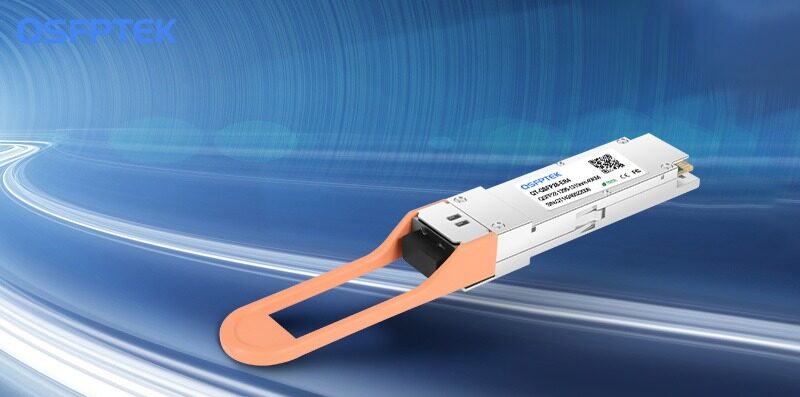
When 100G ER4 Is the Right Choice for Metro and DCI Networks
As metro and data center interconnect (DCI) networks continue to expand, network architects face a growing range of 100G optical options, from CWDM4 and LR4 to coherent ZR solutions. Among these choices, 100G ER4 occupies a distinct and often misunderstood position. Rather than being defined solely by its nominal 40 km reach, ER4 should be evaluated based on how it fits specific metro and DCI design requirements.
Beyond Distance: Understanding the ER4 Value Proposition
100G ER4 uses LAN-WDM wavelengths and EML lasers, delivering higher optical output power and better dispersion tolerance than short-reach alternatives. This makes ER4 particularly suitable for unamplified, point-to-point links that must traverse multiple patch panels, optical distribution frames, or older fiber plant. In metro environments, fiber routes are rarely clean or direct, and cumulative insertion loss often becomes the real limiting factor.
Unlike coherent optics, ER4 operates in a grey, client-side form factor. This allows direct connection between routers or switches without the need for transponders, amplifiers, or specialized line systems. For many metro and DCI deployments, simplicity and operational familiarity are just as important as raw reach.
When ER4 Fits Metro Network Design
Metro networks often aggregate traffic from access and aggregation layers into core nodes distributed across a city. In this context, link stability and predictability matter more than extreme spectral efficiency. ER4 excels when link distances fall into the 10–40 km range, but the optical path includes uncertainty, such as leased fiber, unknown splice quality, or evolving patching.
ER4 also aligns well with ring or hub-and-spoke topologies, where traffic patterns are stable and links are provisioned for long service lifecycles. Its higher power budget provides headroom for future reconfiguration without forcing a redesign of the optical layer.
ER4 in Practical DCI Scenarios
In DCI environments, especially those connecting enterprise or regional data centers, ER4 offers a compelling balance between reach and complexity. Not every DCI link justifies the cost, power consumption, and operational overhead of coherent optics. For single-span DCI links that do not require optical amplification, ER4 delivers predictable performance with minimal integration effort.
Additionally, ER4 supports direct router-to-router or switch-to-switch connections, reducing latency and eliminating intermediate equipment. This can be advantageous for latency-sensitive applications such as financial systems, replication workloads, or distributed storage.
Cost, Power, and Operational Trade-offs
While ER4 is more expensive than LR4 or CWDM4 modules, its cost must be evaluated in the context of the entire system. Avoiding amplifiers, transponders, and complex optical management can offset higher module pricing. Power consumption, though higher than short-reach optics, remains significantly lower than coherent solutions.
Operationally, ER4 benefits from widespread standards support and mature interoperability, making it easier to deploy in multi-vendor environments.
When ER4 Is Not the Right Choice
ER4 is not ideal for ultra-long-haul DCI links requiring amplification, nor for ultra-dense DWDM environments where spectral efficiency is critical. In such cases, coherent solutions provide better scalability.
Conclusion
100G ER4 is the right choice for metro and DCI networks when simplicity, reliability, and moderate long reach are the primary design goals. By focusing on real-world network constraints, fiber quality, operational complexity, and lifecycle stability—ER4 remains a highly relevant solution in modern metro and inter-data-center architectures.