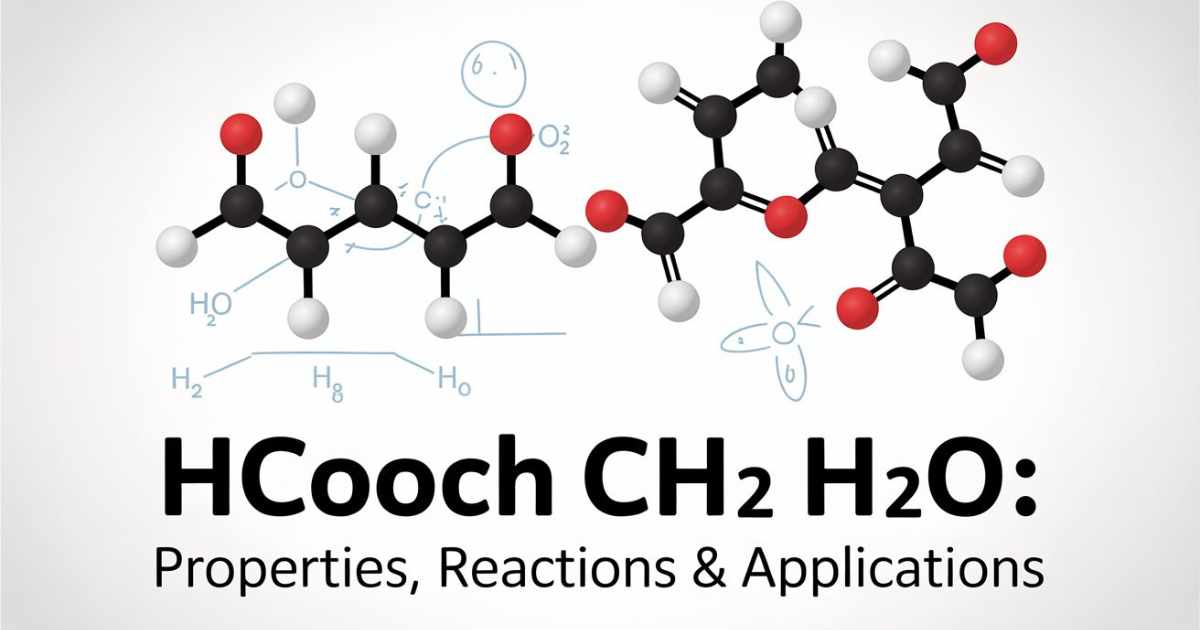
HCOOCH CH2 H2O: Properties, Reactions & Applications
Introduction
The chemical formula HCOOCH CH2 H2O represents a unique combination of a formate ester (HCOOCH), a methylene group (CH2), and water (H2O). While it appears simple, this compound is crucial in organic chemistry, industrial synthesis, and laboratory experiments.
Esters like HCOOCH CH2 H2O are studied extensively due to their reactivity, versatility, and practical applications. Understanding this compound helps chemists and students explore reaction mechanisms, molecular interactions, and industrial relevance.
This guide covers structure, properties, reactions, applications, analytical methods, safety, and FAQs, providing a complete resource for learners and professionals.
Chemical Composition of HCOOCH CH2 H2O
1. HCOOCH – Formate Ester Group
- Contains carbonyl (C=O) and ether (O–C) linkages
- Polar nature enhances water solubility
- Participates in esterification, hydrolysis, and transesterification reactions
- Industrial uses: pharmaceuticals, flavorings, solvents
Example: Methyl formate (HCOOCH3) has similar chemical behavior, demonstrating the reactivity of formate esters.
2. CH2 – Methylene Group
- Acts as a linker between functional groups
- Influences molecular geometry, flexibility, and reactivity
- Involved in addition, substitution, and polymerization reactions
- Essential in organic synthesis and industrial applications
3. H2O – Water Molecule
- Acts as reactant or solvent in chemical reactions
- Stabilizes molecular structure through hydrogen bonding
- Influences solubility, polarity, and reaction rates
- Essential in green chemistry processes and laboratory experiments
Structural Interpretation
HCOOCH CH2 H2O can be visualized as:
- Covalent bonds connecting carbon, hydrogen, and oxygen
- Polar regions due to ester and water molecules
- Flexible CH2 bridge, enabling chemical reactions
- Hydrogen-bonding interactions in aqueous solutions
Diagram (textual representation):
   HCOOCH – CH2 – H2O
     |       |       |
   C=O      CH2     H-O-H
Physical and Chemical Properties
| Property | HCOOCH CH2 H2O Description |
|---|---|
| State | Liquid at room temperature |
| Color | Colorless to pale yellow |
| Odor | Mildly fruity (typical of esters) |
| Solubility | Soluble in water & polar organic solvents |
| Boiling Point | ~100–120°C (depends on hydration) |
| Melting Point | ~0–5°C |
| Polarity | Polar molecule due to ester & water |
| Reactivity | Hydrolysis, esterification, addition, polymerization |
| Stability | Stable under normal conditions, reactive under heat/acid/base |
| Hydrogen Bonding | Present due to water and ester groups |
Chemical Reactions
1. Hydrolysis
Reaction:
HCOOCH CH2 + H2O → HCOOH + CH3OH
- Acidic hydrolysis: HCl catalyzes ester breakdown
- Basic hydrolysis (saponification): NaOH forms formate salt and alcohol
- Commonly demonstrated in organic chemistry labs
2. Combustion
Reaction:
HCOOCH CH2 H2O + O2 → CO2 + H2O + Energy
- Releases energy
- Shows potential as bio-derived fuel source
- Demonstrates stability of ester molecules under high temperature
3. Addition & Substitution
- CH2 groups react with halogens or nucleophiles
- Forms substituted organic compounds
- Water stabilizes intermediate compounds
4. Polymerization
- Can form polyesters or resins
- Water affects molecular weight and polymer properties
- Industrial relevance: plastics, coatings, and adhesives
Applications
Industrial Applications
- Solvents for paints, coatings, and chemical processes
- Precursors for pharmaceuticals and polymers
- Fragrance and flavoring agents
Laboratory Applications
- Demonstrates ester hydrolysis, substitution, addition reactions
- Helps students understand molecular interactions
- Essential for research in organic synthesis
Emerging Research
- Green chemistry alternatives
- Biodegradable polymer production
- Pharmaceutical derivatives
Analytical Methods
- IR Spectroscopy: Detect ester carbonyl (~1735 cm⁻¹)
- NMR Spectroscopy: Identify CH2 protons & carbonyl carbons
- Mass Spectrometry: Molecular weight & fragmentation
- Chromatography (HPLC/GC): Purity & reaction monitoring
Safety & Environmental Considerations
- Use gloves, goggles, and ventilation
- Store in cool, dry, ventilated areas
- Avoid environmental release; toxic to aquatic life in high concentrations
- Dispose of according to chemical safety regulations
Importance in Education
Studying HCOOCH CH2 H2O helps:
- Learn ester and methylene chemistry
- Understand reaction mechanisms
- Develop practical laboratory skills
- Explore industrial applications in pharmaceuticals and polymers
Comparison with Similar Compounds
- Similar to methyl and ethyl formate
- Differences in CH2 placement affect boiling point, solubility, and reactivity
- Selecting the correct compound is crucial for research and industrial processes
Frequently Asked Questions (FAQs)
A1: It is used in organic synthesis, laboratory experiments, polymer production, and as a chemical intermediate in industries.
A2: Yes, with proper gloves, goggles, and ventilation, but avoid ingestion or environmental release.
A3: The CH2 group provides flexibility, acts as a reactive site, and bridges functional groups, influencing reactivity.
A4: Yes, in acidic or basic media, the ester group reacts with water to produce alcohol and formic acid.
A5: It’s used as a solvent, polymer precursor, fragrance/flavor agent, and pharmaceutical intermediate.
Conclusion
HCOOCH CH2 H2O is a versatile compound with significance in organic chemistry, industry, and research. Its combination of formate ester, methylene, and water allows for diverse chemical reactions, industrial applications, and educational uses.
By understanding HCOOCH CH2 H2O, chemists and students can predict reactions, design syntheses, and explore innovative applications in pharmaceuticals, polymers, and green chemistry.